
Automated Hazard Analysis and Risk Assessment
Hardware Compliance generates exhaustive HARA documents for robotics, medical device, and automotive compliance — covering every foreseeable hazard your standard requires.

Why HARA Stops Most Hardware Teams Cold
Hazard analysis and risk assessment is the most technically demanding document in any certification package. It demands simultaneous mastery of regulatory methodology — risk matrices, ALARP principles, severity and probability estimation — and deep product-domain expertise. Most compliance consultants strong in one area are weak in the other. Specialist consultants who can do this well are scarce, expensive, and slow. And because HARA is foundational, every downstream document — your test plan, safety design specs, user instructions, and labeling — depends on getting it right the first time. Hardware Compliance encodes the regulatory and domain expertise of its founders directly into its AI-driven HARA generation system, producing complete, standard-specific risk assessments built to pass lab review.
Hazard Identification
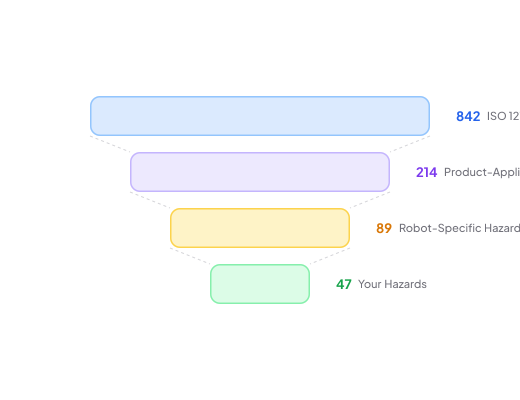
Every Foreseeable Hazard, Systematically Found
The AI applies standard-specific hazard taxonomies to identify every applicable hazard — ISO 12100 Annex A categories for machinery, ISO 14971 intended use analysis for medical devices, and robot-specific hazard classes from UL 3300 and ISO 13482.
- ISO 12100 Annex A taxonomy applied
- Robot collision and entanglement scenarios
- Medical device use-error identification
Risk Methodology
The Right Risk Framework for Each Standard
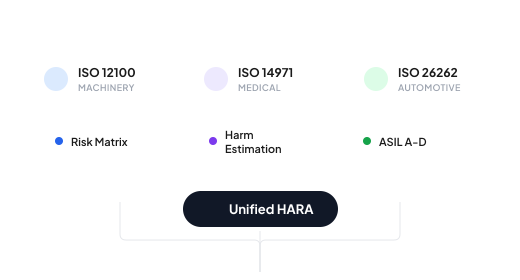
HARA is not one-size-fits-all. The AI applies the precise risk estimation methodology mandated by each applicable standard — ISO 12100 risk matrix for machinery, ISO 14971 harm estimation for medical devices, and ISO 26262 ASIL determination using Severity, Exposure, and Controllability.
- ISO 14971 harm estimation process
- ISO 26262 ASIL level determination
- Standard-prescribed severity and probability ratings
Risk Reduction
Structured Risk Reduction Measure Proposals
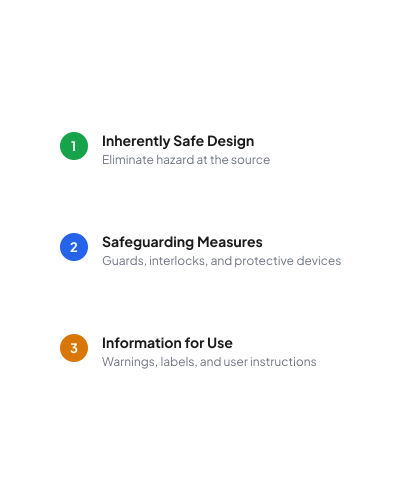
For every hazard that exceeds acceptable risk thresholds, the AI proposes risk reduction measures following the three-level hierarchy mandated by standards: inherently safe design first, then safeguarding and protective measures, then information for use.
- Three-level reduction hierarchy applied
- Measure traced to specific hazard
- Residual risk re-evaluated after mitigation
Robotics Safety
Human-Robot Interaction Hazard Analysis
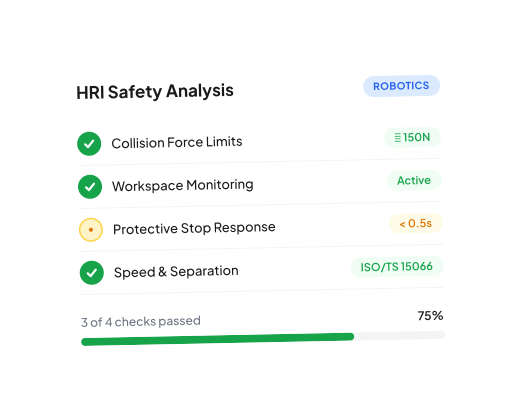
For robotics products, the AI performs specialized human-robot interaction safety analysis — covering collision force scenarios, workspace monitoring requirements, protective stop conditions, and speed and separation monitoring per ISO/TS 15066.
- ISO/TS 15066 separation monitoring covered
- Protective stop scenario documentation
- Autonomous movement hazard analysis
Document Propagation
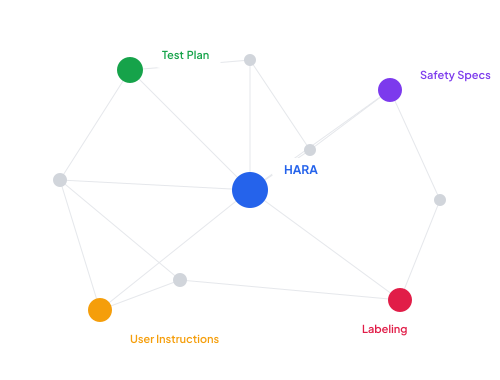
HARA Findings Flow Into Every Downstream Doc
HARA outputs are not isolated. Hardware Compliance propagates risk findings into your test plan, safety design requirements, user instructions, and labeling content — ensuring full traceability and consistency across the entire technical file.
- Test plan requirements auto-derived
- Labeling and warning content updated
- Full hazard-to-requirement traceability
Generate Your HARA Before Your Next Lab Submission
See how Hardware Compliance builds a complete, standard-specific hazard analysis and risk assessment for your product.
Book a Call